 Kluthe Magazine
Drying and corrosion protection through water displacement
Metal parts can be dried in many ways, including through the application of heat. However, this drying method has the drawback of being energy-intensive and time-consuming. Most importantly, there is no absolute guarantee that all moisture will be removed. In certain downstream processes, residual moisture can negatively affect product quality and reduce the service life of metal parts. Any remaining moisture on metal surfaces is always a potential starting point for corrosion. Anyone looking to reliably avoid both issues should use dewatering.
Drying by water displacement: the principle of dewatering
Dewatering uses water-displacing substances. These molecules are hydrophobic and reduce the interfacial tension on the metal surface. Figuratively speaking, they penetrate the aqueous surface film on the metal, displace it, and cause the water to bead up and roll off. Substances with these properties include aliphatic hydrocarbons such as isoparaffins or petroleum distillates. In a large number of cases, they replace the volatile organic compounds (VOCs) that were frequently used in the past. The use of which is now heavily restricted by U.S. environmental and air quality regulations. Water-displacing substances may or may not contain corrosion protection additives. This decision depends on the intended subsequent use of the workpiece.
Advantages of dewatering
Protection against corrosion
If corrosion is to be prevented, absolute dryness is essential. Even small amounts of residual water on a metal workpiece can lead to secondary defects that, in the worst case, only become apparent at a very late stage of the process. One such delayed consequence is under film corrosion beneath a final paint coating. This can lead to costly rework or even scrapping the product if the defect can no longer be remedied. To avoid this scenario, dewatering should be used as the drying method. Numerous products available on the market contain additional substances that provide corrosion protection. Some offer short-term protection, others longer-term corrosion protection. Some are designed for temporary indoor storage, while others protect components even when stored outdoors. In addition to storage conditions, the subsequent processing steps also play a role in selecting the appropriate water displacer.
Fast, simple, and dependable
Metal parts can be dried using heat, but such processes are time-consuming and energy-intensive. In contrast, dewatering typically takes only a few minutes and is conducted at room temperature. Most importantly, it ensures that water is completely displaced from the metal surface. Compared to conventional thermal drying methods, dewatering is therefore superior in terms of time efficiency, resource consumption, and overall performance.
Practical application
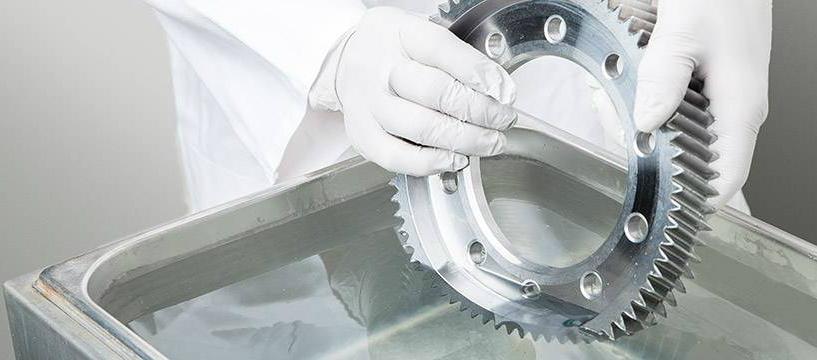
In general, dewatering products are used undiluted. The metal parts to be dried can be immersed in baths, sprayed with the water displacer, or applied using a brush.
Considerations for immersion baths
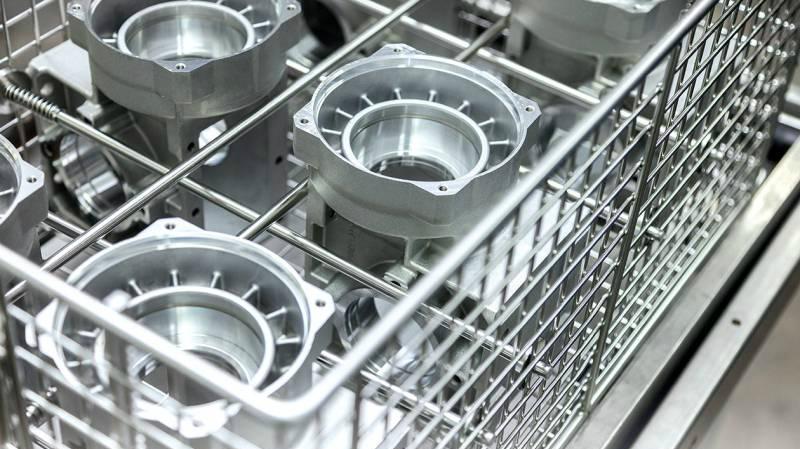
When metal parts are dried in an immersion bath, the displaced water settles at the bottom of the tank. To support this separation of the aqueous phase, immersion baths typically have a sloped bottom and a drain at the lowest point. This drain is used to remove the aqueous waste. Often, a perforated intermediate floor is also installed above the sloped bottom and drain. The metal parts are placed in mesh baskets and immersed in the bath. The intermediate floors and mesh baskets are additional safety measures designed to prevent the metal parts from making contact with the water collected at the bottom. Immersion times range from about 30 seconds to 4 minutes, depending on the substance used. Most water-displacing substances are volatile, which is why immersion baths are usually equipped with a lid. The volume of the immersion tank depends on the size of the metal parts being treated and the required throughput. Higher throughput generally calls for a larger immersion bath.
Spraying
An immersion bath is not always available, and sometimes only relatively small quantities of metal parts need to be processed. In such cases, investing in an immersion bath may not be economically viable. It is also less suitable for components with complex geometries, as there is a risk that the parts will not be fully wetted and therefore not completely dried. In these situations, a spraying process is a suitable alternative. The water displacer is applied using a spray gun. To protect against finely dispersed substances, the operator must observe specific safety measures, including respiratory, eye, and hand protection as part of personal protective equipment. The moisture film removed from the surface must be collected in a drip tray and disposed of in accordance with applicable regulations. Proper application, disposal, and required safety measures are described in the safety data sheet provided by the manufacturer.
Application with a brush
A third application method is brushing. Here, too, the same protective measures as for spraying must be observed. If there is a possibility of volatile vapors forming, therefore, adequate ventilation or exhaust systems must be provided for both manual brush application and spraying.
When is fast and, above all, complete drying required?
Drying by water displacement is particularly suitable for workpieces that are contaminated with water-miscible metalworking fluids after machining. After a rinsing step, dewatering is recommended when a coating or painting process follows. Electroplating and phosphating are also typical processes in which dewatering is used as an intermediate drying step.

Corrosion protection as an additional benefit
Water displacers often contain additional corrosion protection additives. Whether these are required depends on the subsequent treatment steps. If the part is processed immediately, additional corrosion protection is usually not necessary. Pure water displacers are sufficient when another protective layer or paint coating is applied shortly afterward. In some cases, a workpiece is intended to be “only” dried, without leaving visible water spots. In this case, too, pure dewatering without added corrosion protection is sufficient. If corrosion protection is desired, users can choose from a variety of options. For longer storage periods, external conditions are decisive. For intermediate indoor storage, a thin protective film is usually sufficient. The same applies to preserving workpieces and small parts stored for extended periods in shipping packaging. However, when machine components or spare parts are stored or transported outdoors for longer periods, stronger protection is needed. In such cases, the parts should be coated with a thicker protective layer that provides effective corrosion protection. This layer is typically wax-like, sometimes lacquer-like, and non-tacky. For special applications, such as plain bearings or hinges, water displacers are available that contain additives such as molybdenum disulfide, which acts as a lubricant and helps maintain sliding performance.
Dewatering is a process that not only saves time and resources but also reliably protects treated parts against corrosion. It is therefore a dependable alternative whenever even the slightest traces of residual moisture on metal parts are undesirable.