 Kluthe Magazine
« Which Industrial Cleaner for Which Purpose? »
Industrial cleaners are designed to remove production-related contaminants from parts during manufacturing. They are also used to keep machines, equipment, and buildings clean. Different cleaning tasks require distinct types of cleaners. These include solvent-based products and water-based formulations. Naturally, water-based cleaning agents are preferred, as they achieve their effect primarily by using water, making them the more environmentally friendly option. However, certain types of contamination or surfaces that are sensitive to water require the use of specific solvents or solvent blends.
Solvent-Based Cleaners for Stubborn Greasy Contamination
Solvent-based cleaners consist of organic compounds. These industrial cleaners are also known as cold cleaners. They are particularly well suited for removing oils, greases, and waxes. For many years, halogenated hydrocarbons such as carbon tetrachloride were used for this purpose. Once it became known that these substances damage the ozone layer, their use was prohibited.
Petroleum ether is frequently used as a cleaner and solvent for grease-based contamination. However, handling petroleum ether requires strict fire protection and occupational safety measures. Its vapors form atmospheres that must be prevented from igniting. Its strong degreasing effect can also cause skin damage after prolonged and repeated contact.
Solvent Cleaners for Specialized Applications
As an alternative to universal petroleum ether, Kluthe has developed solvent-based cleaners tailored to specific types of contamination. These specialty cleaners consist of various hydrocarbon blends.
They are primarily based on modified alcohols. As with all solvent-based cleaning agents, compliance with health and fire safety requirements is essential.
Under the brand name NIKUTEX 2003, Kluthe offers a solvent suitable for the residue-free removal of numerous metalworking fluids as well as machining oils. A key focus during the development of this cleaner was the option for use in closed-loop solvent recovery. Partial reconditioning of the solvent blend allows for repeated reuse, resulting in particularly high efficiency. Oils, greases, and waxes can be effectively removed at room temperature using the Kluthe’s cold cleaner, HAKU 1025.
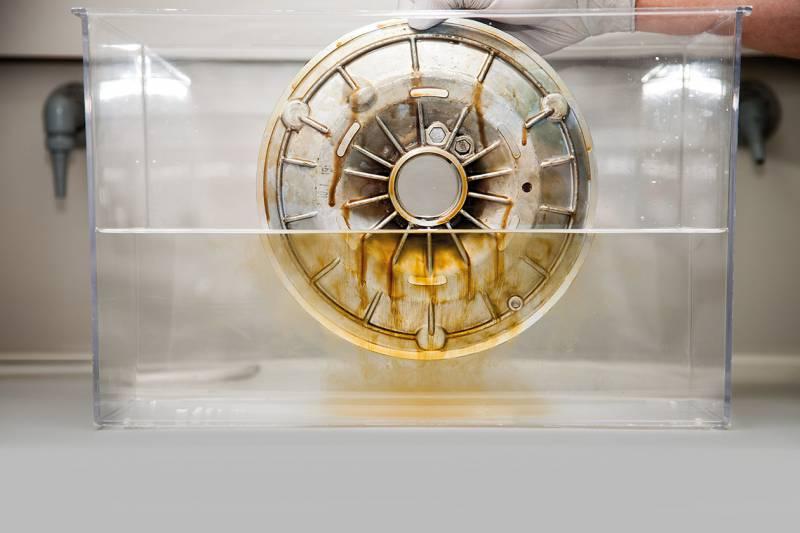
Oils and greases are required to protect workpiece surfaces during machining against corrosion or friction. In many cases, waxes serve as release agents, in items such as casting molds. Kluthe’s HAKU 1025 completely dissolves these substances. The mixture of cleaner and contamination then evaporates from the surfaces without leaving residue. Oil carbon deposits, adhesive residues, and paint residues are especially challenging because they are often engineered to resist chemical removal. Our specialty cleaner HAKUTEX is specifically formulated for such contamination. This solvent enables reliable cleaning of various surfaces while also providing surface care.
Solvent-Based Cleaning Methods
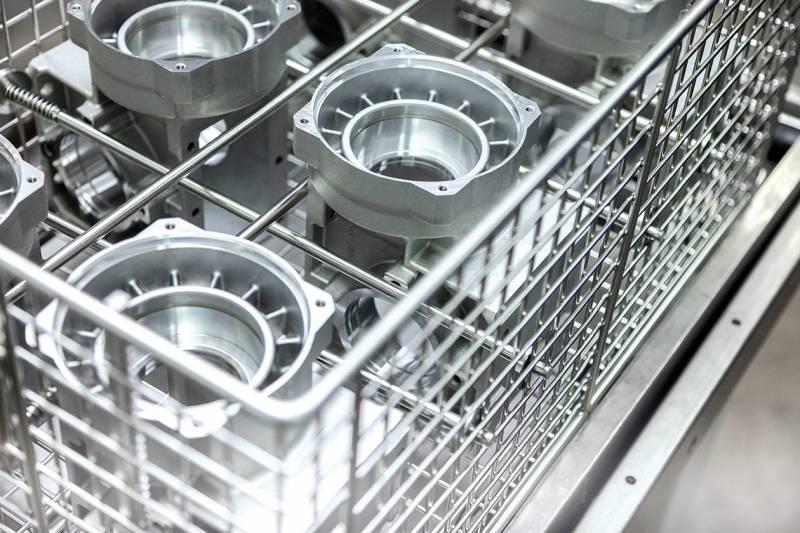
Cleaning with solvents is often performed by using immersion processes. Immersion tanks allow targeted extraction and treatment of vapors as well as an exposure time tailored to the level of contamination. During immersion, the cleaning fluid also reaches areas of the workpiece that are difficult to access.
To a limited extent, such as in smaller workshops—machine parts can also be cleaned manually using solvent-based industrial cleaners.
These cleaners are sprayed on or applied with brushes and then wiped off with cloths.
Water-Based Industrial Cleaners – How They Work
Water-based cleaners are supplied as concentrates, and which are diluted with water before use. The required concentration depends on the type of contamination and the composition of the cleaner. Detailed information regarding dilution, can be found in the manufacturer’s technical data sheet (TDS). Typical application concentrations range between 0.2 and 15 percent. In addition to concentration, the effectiveness of the cleaning solution depends on operating temperature. Depending on the application, temperatures typically range from 68 to 176 °F. Another factor influencing cleaning performance is the pH level of the solution. Modern products aim for a neutral pH level. For most applications, particularly greasy contamination, alkaline cleaners are used.
Special cleaning agents for use on lime-scale deposits or for when a simultaneous pickling effect is desired, have an acidic character. The physical and chemical interactions that lead to the removal of contamination result from carefully balanced ingredients. Inorganic, ionic, and nonionic substances are used for this purpose. Surfactants play a key role in the performance of water-based cleaners. Their molecular structure includes a water-attracting and an oil- or grease-attracting component. This enables the dispersion of substances in water that would not normally dissolve in water.
Processing Methods with Water-Based Cleaners
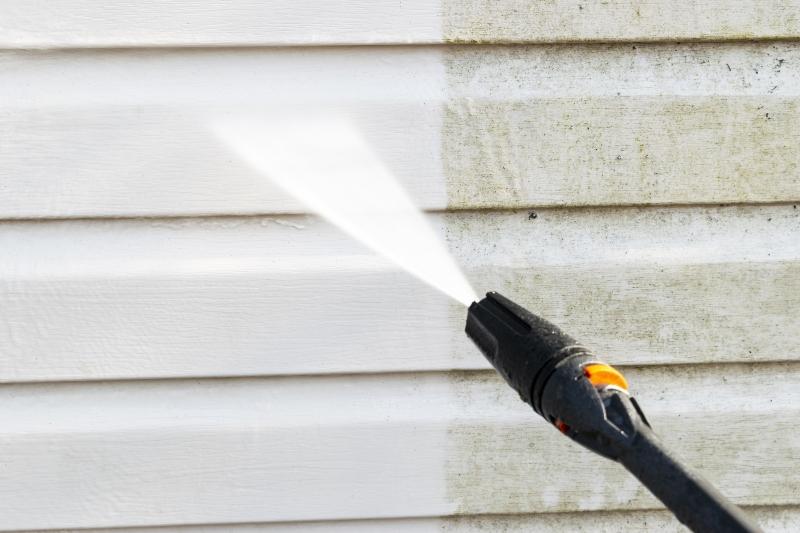
Water-based cleaners are suitable for all common cleaning methods. In spray processes, the cleaning solutions are applied to the parts through nozzles under high pressure.
The chemical cleaning action is enhanced by the mechanical forces generated when the solution impacts the surface.
The mixture of cleaner and contamination is collected beneath the parts and, depending on the degree of contamination, it is either reused in a recirculation system or disposed of. In immersion processes, the cleaning solution is held in tanks. There, the solution can be relatively easily brought to and maintained at operating temperature.
The effect of the cleaning agent can be enhanced by ultrasonic treatment. Ultrasound generates pressure waves in the aqueous solution, producing localized gas bubbles in the liquid. This process is known as cavitation. When the bubbles implode near the contaminated surface, the resulting pressure pulses remove contamination.
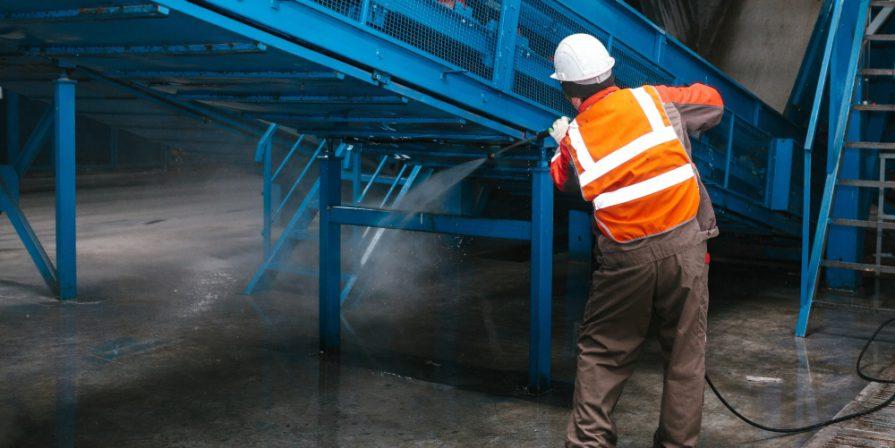
Except for special applications, machines, systems, and buildings are cleaned using water-based cleaning agents.
Selection of the Optimal Cleaning Agent
Solvent-based or water-based cleaning agents should always be selected according to the specific application. To identify the “right” product among the wide range available, the type of contamination, the surface requirements, and the cleaning process used must be clearly defined. Based on this information, a targeted selection can be made.
If persistent production-related contamination regularly occurs during manufacturing processes (e.g., deposits of chemical substances, release agents, or polishing pastes), cleaners can be developed specifically for these requirements. Modern manufacturers of industrial cleaners such as Kluthe have the equipment, concepts, and experience necessary to enable optimal cleaning processes.