« How Reconditioned Barrels Help Reduce CO2 Emissions »
Barrels are a widely used packaging solution for chemicals consumed throughout the industrial sector. Lubricants, cleaning agents, corrosion protection products, paints, and coatings can be safely stored and transported in them, protected from environmental influences. The large number of deliveries alone represents significant potential for greater climate protection. Using reconditioned barrels can reduce CO2 emissions. Read on to discover how this process works and how you can take part.
When Barrels Can Be Reconditioned
Steel and plastic barrels can be reconditioned if certain requirements are met. They must be:
- undamaged
- emptied of residues (free-flowing, drip-free, or scraped clean)
- pretreated if they contained toxic, corrosive, or strong-smelling materials (product-free, neutralized, and odor-free)
- free from product residues on the outside
- tightly sealed
- labeled with information about the last contents
- suitable for proper cleaning
In addition, plastic barrels used for hazardous substances have a maximum service life of five years, since plastic materials age over time. For steel barrels, the wall thickness must still be at least 0.04 inches (1 mm). If all these conditions are met, the reconditioning of barrels containing hazardous materials can be performed by a certified company. Be sure to leave all labels and markings that provide information about the former contents on the barrels. This enables the reconditioner to select the appropriate cleaning method for the interior.
Incidentally, empty steel and plastic barrels that are reused within the chemical industry are considered products. A deformed or otherwise damaged barrel sent for repair or recycling, on the other hand, is classified as waste. Using reconditioned barrels therefore not only contributes to reducing CO2 emissions but also improves the overall waste balance. To take advantage of this benefit, a formal declaration is required—available as standardized forms—confirming that the container has been emptied and is intended for reconditioning.
© Wiski – stock.adobe.com
How Barrels Are Reconditioned
Reconditioning means preparing barrels for reuse. This distinguishes it from recycling or other forms of recovery. During reconditioning, the barrel remains intact as a transport and packaging unit. In recycling, only the material itself is returned to the production cycle, requiring a corresponding amount of energy. In other recovery methods such as incineration, plastic barrels may generate energy but also release CO2.
CO2 reductions are achieved when steel and plastic barrels are simply restored for reuse. Steel barrels receive thorough internal and external cleaning, new gaskets, and if necessary, new closures. The internal cleaning may be thermal or chemical, depending on the last contents. In thermal cleaning, barrels are carefully thermally treated under controlled conditions and then repainted. Chemical cleaning is accomplished by using hot steam or hot water and the necessary cleaning agents.
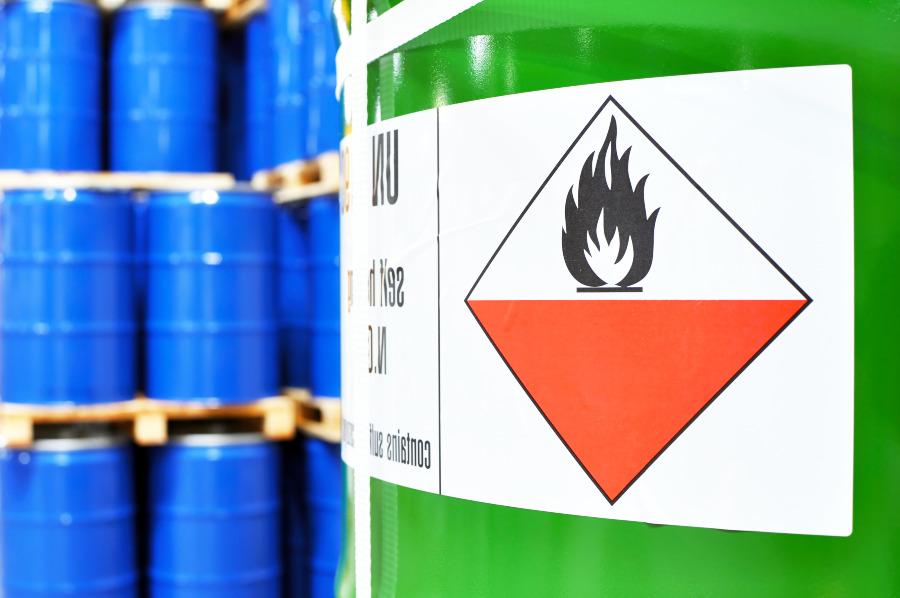
Plastic barrels are also thoroughly cleaned inside and out; closures and gaskets are replaced. For barrels intended to be used for transporting hazardous goods (identified by the UN marking), additional inspection for integrity and required labeling is performed. Reconditioned barrels for liquids must also undergo a leak-tightness test.
© industrieblick – stock.adobe.com
Who Performs Barrel Reconditioning
Most products supplied by the chemical industry in barrels are classified as hazardous materials. During transport, they are classified as dangerous goods. The containers used are subject to type-approval testing—in Germany, this process is carried out by the Federal Institute for Materials Research and Testing (BAM), and in the United States by the Department of Transportation (DOT). When barrels are reconditioned, their approved design must not be altered. The new gaskets and closures used must also comply with the original design.
To ensure this, reconditioners of hazardous-material barrels must operate under a recognized Quality Assurance Program (QSP) that describes their reconditioning procedures. In Germany, this program is approved following an initial audit and annual inspections by BAM and similar certification processes exist in the US under DOT and EPA oversight. Each certified company receives an identification code, which becomes part of the labeling on reconditioned barrels.
The QSP may also specify that cleaning methods follow the principles of circular chemistry, including the selection of cleaning techniques, the chemicals used, and the handling of waste residues from reconditioning. Industry-wide return systems for industrial packaging operate in both Germany (under the Packaging Act) and the United States, and are operated by certified barrel reconditioning companies.
Circular Chemistry in Reconditioned Barrels at Kluthe
Since circular chemistry has been part of Kluthe’s corporate philosophy from the very beginning, the company embraces every opportunity to apply best practices in this field. Consequently, Kluthe also offers its products in reconditioned barrels. The CO2 savings amount to roughly two-thirds compared with newly produced barrels that are recycled after a single use. Over the course of a year, this adds up to more than 660,000 lbs. (≈ 300,000 kg) of CO2 saved.
This reduction is achieved by extending the service life of the containers. The need for raw materials, transport, manufacturing energy, and waste disposal associated with producing and discarding single-use barrels is eliminated with the use of reconditioned ones.
In addition to reducing CO2 emissions, conserving resources such as water and processing materials has further positive environmental effects. This is reflected in the process by which customers return their empty barrels for reconditioning. Kluthe’s own logistics service collects empty containers during deliveries of new products, which can often be refilled and reused with the same chemical product after cleaning.
By using reconditioned barrels and returning them for reconditioning, customers also reduce their own CO2 emissions and waste—while saving disposal costs.